Introduction
Heat buildup is one of the most persistent threats in industrial and commercial facilities. When cooling systems fall short, production slows, energy costs climb, and critical electronics overheat. Air heat exchangers are among the most effective tools for addressing this directly — recovering waste heat that would otherwise be lost while protecting sensitive equipment from harsh operating environments.
That protection starts with understanding what these systems actually do. An air heat exchanger transfers thermal energy between two separate air streams — or between air and another medium — without allowing them to mix. Heat moves from the warmer side to the cooler side through a conductive barrier, reducing the load on primary HVAC and cooling equipment while preserving air quality and contamination control.
This guide covers the types of air heat exchangers, how they work, where they're used, and how to protect them from the corrosive environments that threaten their performance. Engineers, facility managers, and manufacturers in oil refining, petrochemical, aerospace, and HVAC will find practical guidance for optimizing heat recovery, extending equipment life, and reducing operating costs.
TLDR:
- Air heat exchangers transfer heat between air streams without mixing them, cutting HVAC and cooling loads
- Modern systems reach 50–85% heat recovery efficiency; counterflow designs perform best
- Fin-fan coolers eliminate water consumption entirely — the air-cooled heat exchanger market is projected to reach $5.69B by 2029
- Diffusion coatings like aluminizing dramatically extend service life in corrosive and high-temperature environments
- Key applications include HVAC energy recovery, industrial enclosure cooling, and petrochemical heat rejection
What Is an Air Heat Exchanger?
An air heat exchanger is a device that transfers thermal energy between two separate air streams—or between air and another medium—without the two streams mixing. A conductive barrier or element (metal foil, finned tubes, heat pipes) moves heat from the warmer side to the cooler side, allowing facilities to recover waste heat or reject process heat efficiently.
How Air Heat Exchangers Differ from Liquid-Based Systems
The working fluid on at least one side is air or gas, which has significantly lower thermal conductivity than liquids. To compensate, air heat exchangers require significantly more surface area through fins, corrugations, or extended surfaces—without these enhancements, heat transfer rates would be too low for practical use.
The thermal conductivity gap explains why:
| Medium | Thermal Conductivity at 300 K |
|---|---|
| Air | 0.026 W/m·K |
| Water | 0.6 W/m·K |
That 23x difference drives the need for extended surface geometries in every air-side heat exchanger design.
Two Primary Use Contexts
HVAC and Building Ventilation: Heat Recovery Ventilators (HRVs) and Energy Recovery Ventilators (ERVs) recover heat from exhaust air to pre-condition incoming fresh air, reducing heating and cooling loads in commercial and residential buildings.
Industrial Enclosure and Process Cooling: Sealed air-to-air heat exchangers remove heat generated by electrical equipment while keeping enclosures sealed against dust, moisture, and corrosive gases—critical in manufacturing, mining, and refinery environments.
The term "air heat exchanger" covers both air-to-air systems and air-to-liquid systems (one side air, one side water or refrigerant). This guide addresses both HVAC recovery and industrial cooling applications where air is the primary working fluid on at least one side.
How Does an Air Heat Exchanger Work?
Heat always flows from a higher-temperature region to a lower-temperature region. In an air heat exchanger, two airstreams are separated by a thermally conductive surface—metal foil, finned tubes, heat pipes, or corrugated plates. Heat conducts through that barrier from the hot stream to the cold stream, transferring energy without mixing the air.
Three Primary Flow Arrangements:
The direction and pattern of airflow directly affect performance:
| Flow Type | Configuration | Efficiency | Trade-offs |
|---|---|---|---|
| Parallel Flow | Both streams enter same end | Lower (up to 50%) | Simpler design, lower cost, limited temperature differential |
| Counterflow | Streams flow opposite directions | Highest (50-75%+) | Maximum temperature differential, can approach 100% theoretically |
| Crossflow | Streams flow perpendicular | Moderate (50-70% single-pass, 60-85% multi-pass) | Compact size, balances efficiency with footprint |
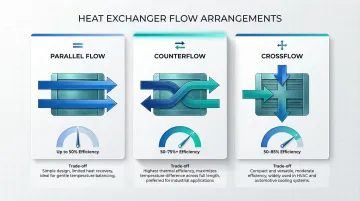
Counterflow configurations achieve the highest effectiveness because the temperature differential between streams remains high throughout the exchanger. Crossflow designs are typical in finned-tube HVAC applications where space constraints make perpendicular flow paths practical.
Surface Area: The Key Performance Driver
Because air's thermal conductivity is so low, manufacturers maximize heat transfer surface using:
- Aluminum or copper fins bonded to tubes, increasing air-side surface area 10-40 times
- Wavy or embossed foil corrugations that generate turbulence and expand contact area
- Louvered or offset strip fins with interrupted geometries that break up boundary layers and boost heat transfer coefficients
Airflow rate (CFM or m³/h) and temperature differential between streams together determine how much heat is actually recovered. Higher airflow increases heat transfer but also raises pressure drop and fan energy consumption—requiring careful balance. That balance between airflow and pressure directly shapes overall efficiency.
Heat Recovery Efficiency:
Efficiency represents the percentage of available heat transferred from the outgoing warm stream to the incoming cool stream. Factors affecting it include:
- Surface area and fin geometry
- Air velocity and turbulence
- Temperature difference between streams
- Condensation on cold surfaces, which releases latent heat and boosts performance but requires drainage
Condensation Management:
When warm, humid indoor air meets the cold surface of the heat exchanger core, moisture condenses. ASHRAE 62.1 warns that condensate not properly collected or drained leads to downstream wetting and increased potential for mold and microbial growth. Systems must include drainage provisions, correct pitch, and mold prevention measures—especially in food processing, cleanrooms, and high-humidity industrial environments.
Closed-Loop vs. Open-Loop Designs
Closed-Loop Designs (Industrial Enclosure Cooling):
Internal air circulates within a sealed enclosure past the heat transfer element while external ambient air carries away the heat. The two airstreams never mix, protecting sensitive components from dust, moisture, and contaminants. Common applications include:
- Electrical control panels in manufacturing and refinery environments
- Mining equipment enclosures subject to heavy particulate
- Systems requiring NEMA 4/4X/12 ingress protection ratings
Open-Loop/Ventilation Designs:
Fresh outdoor air is exchanged with stale indoor air, common in HVAC and residential HRV systems. These enable higher fresh-air change rates without proportional energy penalties, improving indoor air quality efficiently. They are not suitable, however, where external contaminants must be excluded—cleanrooms and sealed industrial enclosures require closed-loop alternatives instead.
Types of Air Heat Exchangers
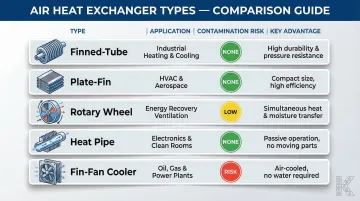
Five main types cover the range from residential HVAC to heavy industrial process cooling. Each suits a different combination of fluid type, contamination tolerance, and operating environment.
Finned-Tube (Air Coil) Heat Exchangers
A liquid refrigerant or chilled water flows through tubes while air passes over aluminum or copper fins bonded to the tubes. This is the most common type in HVAC systems — cooling coils, heating coils, and some industrial enclosure coolers. Fins dramatically increase air-side surface area to overcome air's low thermal conductivity, often making the finned area 10 to 40 times larger than bare tube area.
Plate-Fin Heat Exchangers
Corrugated or flat fins are sandwiched between flat plates to create two separate air channels in a compact, lightweight assembly. Brazed aluminum plate-fin heat exchangers (BAHX) are widely used in:
- Aerospace applications (aircraft intercoolers, charge air coolers)
- Natural gas processing and LNG liquefaction
- Cryogenic systems where multiple streams must be handled in a single unit
Their high surface-area-to-volume ratio makes them the go-to choice where weight and space are constrained.
Rotary Heat Exchangers (Enthalpy/Thermal Wheels)
A slowly rotating porous or honeycomb wheel spans two adjacent air ducts. As it rotates, one half absorbs heat (and sometimes moisture) from the exhaust stream and the other half releases it into the supply stream. These achieve high sensible (65–80%) and latent (50–80%) heat recovery efficiency.
The trade-off is contamination risk. Rotary wheels exhibit inherent Exhaust Air Transfer Ratios (EATR) of up to 3.3% without purge sections, making them unsuitable for hospitals, cleanrooms, or any application requiring strict isolation between airstreams.
Air-to-Air Heat Pipe Exchangers (AAHX)
Sealed heat pipes span both the exhaust and supply air ducts. Liquid inside the pipe evaporates on the hot side, vapor migrates to the cold side and condenses — releasing heat to the supply air — then returns to the hot side by gravity or capillary action.
This passive design delivers zero cross-contamination, no moving parts, and low maintenance. Typical sensible effectiveness ranges from 40–60%. Complete airstream isolation makes heat pipe exchangers the preferred choice for hospitals and pharmaceutical facilities where ASHRAE 170 prohibits systems with leakage potential.
Shell-and-Tube Air Coolers (Fin-Fan Coolers)
Where the previous types primarily serve HVAC and building systems, air-cooled heat exchangers (ACHEs) are built for heavy industrial process cooling. Process fluid flows through finned tubes while fans force ambient air over the exterior — no cooling water required.
Refineries, petrochemical plants, and power generation facilities rely on ACHEs where water cooling is impractical or expensive. Key considerations for these environments include:
- Material selection: Tube and fin alloys must match the corrosivity of the process fluid
- Surface protection: Diffusion coatings like aluminizing extend component life against high-temperature oxidation and sulfidation (corrosion caused by sulfur-bearing gases)
- Fan system reliability: Forced-draft vs. induced-draft configurations affect maintenance access and thermal performance
| Type | Typical Application | Cross-Contamination Risk | Key Advantage |
|---|---|---|---|
| Finned-Tube | HVAC coils, enclosure cooling | None (single fluid) | Widely available, easy to service |
| Plate-Fin | Aerospace, LNG, cryogenics | None | Compact, multi-stream capable |
| Rotary Wheel | Commercial ventilation | Up to 3.3% EATR | High latent + sensible recovery |
| Heat Pipe | Hospitals, pharma, cleanrooms | Zero | Passive, fully isolated |
| Fin-Fan Cooler | Refinery, petrochemical, power | None | No cooling water needed |
Key Industrial Applications of Air Heat Exchangers
HVAC and Energy Recovery in Commercial and Residential Buildings
Heat Recovery Ventilators (HRVs) and Energy Recovery Ventilators (ERVs) use air-to-air heat exchangers to reduce heating and cooling loads by pre-conditioning incoming fresh air using energy from the exhaust stream. NREL/ComStock modeling demonstrates 16% total site energy savings in commercial buildings using ERV/HRV systems, with heating gas savings reaching up to 53% in some applications. However, engineers must account for the 0.65–0.85 in. w.c. added fan pressure drop to ensure net-positive energy savings.
Industrial Process and Enclosure Cooling
Sealed air-to-air heat exchangers protect electrical control panels, drive cabinets, and industrial enclosures in manufacturing, mining, oil drilling, and refinery environments. Where dust, moisture, or corrosive gases make open-air ventilation dangerous for sensitive electronics, closed-loop designs maintain NEMA ratings while efficiently removing heat.
One wood manufacturing plant replaced filter fans with closed-loop air-to-air exchangers after wood dust and diesel exhaust caused repeated system failures — the switch restored reliability without sacrificing energy efficiency.
Petrochemical, Refining, and Power Generation
Where enclosure cooling focuses on protecting electronics, process-side applications demand a different scale entirely. Air-cooled heat exchangers (fin-fan coolers) cool process streams — hydrocarbons, gases, and other fluids — without consuming large volumes of water. The global ACHE market is projected to reach $5.69B by 2029, driven by oil and gas industry demand (29.7% of market). These systems are common in arid regions and offshore platforms where water availability is limited.
By replacing water-based cooling infrastructure, ACHEs offer compounding operational advantages:
- Eliminate cooling towers and associated water treatment systems
- Reduce infrastructure complexity and maintenance overhead
- Lower total cost of ownership over the system's life
Benefits of Air Heat Exchangers
Energy Efficiency and Cost Reduction
By recovering heat that would otherwise be wasted in ventilation exhaust or process streams, air heat exchangers reduce the load on primary heating, cooling, or refrigeration equipment. Commercial buildings retrofitted with DOAS incorporating ERV/HRV achieve 23% heating savings and 10% cooling savings, cutting utility costs directly. The payback period for HVAC heat recovery systems typically ranges from 2-5 years depending on climate and operating hours.
Improved Indoor Air Quality and Contamination Control
Closed-loop designs prevent external contaminants (dust, chemicals, humidity) from entering sensitive enclosures or clean spaces. Ventilation-type exchangers improve air quality by enabling higher fresh-air change rates without proportional energy penalties—critical for meeting ASHRAE 62.1 ventilation standards while controlling operating costs.
Reduced Footprint vs. Water-Cooled Alternatives
Air-cooled designs eliminate the need for cooling towers, water treatment systems, and associated piping. Wet cooling towers consume approximately 50% more water than once-through systems due to evaporation and blowdown. By switching to ACHEs, facilities eliminate several ongoing cost drivers:
- Water treatment chemicals and discharge permits
- Legionella monitoring and mitigation programs
- Liquid-side scaling and fouling maintenance
This simplifies infrastructure and lowers total cost of ownership.
Protecting Air Heat Exchangers from Corrosion and Wear
Air heat exchangers in industrial settings face severe challenges: corrosive gases (H₂S, NH₄HS, chlorides), particulates, high temperatures, and chemical contaminants accelerate surface degradation, fouling, and tube failure. Fouling—deposit buildup on heat transfer surfaces—is one of the leading causes of efficiency loss and unplanned downtime. As fouling increases air-side pressure drop, mass flow decreases, and performance drops substantially below design conditions.
The Role of Protective Surface Coatings
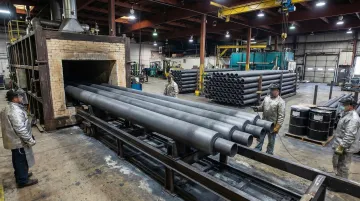
Diffusion coatings such as aluminizing and boronizing create an intermetallic compound layer at the metal surface, improving corrosion and oxidation resistance—particularly in high-temperature or chemically aggressive airstreams. Unlike paint or electroplating, which deposit material on the surface, diffusion coatings form a metallurgical bond that becomes part of the base metal itself.
For heat exchanger operators, this distinction matters. VaporKote applies chemical vapor deposition diffusion coatings using precision on-site powder mixes, allowing the process to be tuned to specific operating environments. Their aluminizing process targets high-temperature corrosion in heat exchanger tubing; boronizing achieves 1500 Knoop surface hardness (RC75+ equivalency) for resistance to wear and erosion. Components treated with these coatings typically outlast untreated materials and many competing surface treatments, reducing replacement frequency and maintenance burden.
Practical Maintenance Guidance
A comprehensive maintenance framework should include:
- Regular inspection for fouling, corrosion, and fin damage (quarterly or semi-annually depending on environment)
- Performance monitoring by tracking overall heat transfer coefficient—efficiency decline signals fouling
- Cleaning methods appropriate to exchanger type:
- High-pressure hydrojetting for finned tubes (carefully, in opposite direction of airflow to avoid fin damage)
- Acid cleaning for scale and mineral deposits (following TEMA guidelines)
- Disassembly and manual cleaning for plate-fin types
- Mold/biological fouling prevention in HVAC applications through proper drainage, P-traps, and periodic UV or chemical treatment
- Hot air recirculation mitigation for multi-bay ACHEs using equal fan elevations, solid plate seals, and wind walls
Design-Stage Protection
Selecting the right coating or material at the design stage is more cost-effective than addressing post-failure repairs. For refineries and petrochemical plants, specifying API 661-compliant materials and protective coatings during procurement prevents premature failure. VaporKote adheres to ASTM, ASME, SAE, and API engineering codes and provides metallurgical analysis and certification of diffusion coatings to support compliance and quality documentation.
Frequently Asked Questions
What is an air heat exchanger?
An air heat exchanger is a device that transfers heat between two air streams (or between air and another fluid) through a conductive barrier without mixing them. It's used in HVAC ventilation, industrial cooling, and process heat recovery to reduce energy consumption and protect equipment.
What is the difference between an air heat exchanger and a regular heat exchanger?
All heat exchangers transfer thermal energy between two streams, but air heat exchangers specifically use air or gas as one or both working fluids. Because air conducts heat far less efficiently than liquids, these units require larger surface areas — achieved through fins, corrugations, or extended surfaces — to hit comparable transfer rates.
What are the main types of air heat exchangers?
The main types are finned-tube air coils, plate-fin exchangers, rotary enthalpy wheels, air-to-air heat pipe exchangers, and industrial air-cooled (fin-fan) units. Selection depends on contamination sensitivity, space constraints, and efficiency targets — rotary wheels offer the highest efficiency but risk cross-contamination, while heat pipes provide zero leakage for critical environments.
Do you really need an air exchanger?
In airtight buildings and sealed industrial enclosures, an air exchanger is essential. Without it, indoor air quality degrades, humidity rises, pollutants build up, and heat-generating equipment risks overheating. Even in less sealed environments, the 16–53% energy savings and air quality gains make a strong case for commercial and industrial facilities.
When should I run my air exchanger?
In most commercial settings, run air exchangers continuously at low speed or on an occupancy-based timer, dialing back during extreme outdoor temperature events to balance air quality with energy use. Industrial enclosure coolers generally run continuously, since any interruption risks equipment overheating.
How efficient is an air heat exchanger?
Modern air-to-air heat exchangers achieve sensible heat recovery efficiencies ranging from 50% to 75% for counterflow plate designs, 65% to 80% for rotary enthalpy wheels, and 40% to 60% for heat pipe systems. Performance varies by type, with counterflow configurations generally achieving higher efficiency than crossflow or parallel-flow designs. Multi-pass crossflow units can reach 60-85% effectiveness.