Introduction
Metal components operating in high-wear, high-corrosion environments fail prematurely, costing industries hundreds of thousands of dollars annually in unplanned downtime and replacement parts. Conventional treatments like nitriding, carburizing, and hard chrome plating frequently fall short when components face abrasive particles, corrosive media, and extreme temperatures simultaneously—particularly in oil and gas, mining, and agriculture.
Boronizing (also called boriding) offers a proven alternative. This thermochemical diffusion process has been applied in heavy industry for decades to dramatically extend component life, yet remains poorly understood compared to more familiar surface treatments.
Unlike deposited coatings that can delaminate, boronizing creates an ultra-hard boride case layer (harder than tungsten carbide) that is metallurgically bonded to the substrate, providing resistance to abrasive wear and corrosion in a single treatment.
This article explains what boronizing is, how the process works step by step, which industries and components benefit most, and the key factors that determine whether it is the right treatment for a given application.
Key Takeaways
- Boronizing diffuses boron atoms into metal surfaces at high temperature, forming a hard boride case layer
- Achieves 1500–2300 HV hardness (RC75+ equivalent)—harder than tungsten carbide cutting tools
- Provides superior resistance to abrasion, wear, and corrosion in a single treatment
- Treated components last two to five times longer than parts with conventional treatments
- Forms a permanent metallurgical bond—no delamination risk unlike applied surface coatings
What Is Boronizing?
Boronizing is a thermochemical surface-hardening process in which a workpiece is heated in a boron-rich environment, causing boron atoms to diffuse into the base metal and chemically react with it. In ferrous materials, this forms metal boride compounds (most commonly Fe₂B and FeB), while nickel, cobalt, and titanium alloys form analogous borides.
The result is a dense, hard case layer metallurgically bonded to the substrate—not a deposited film or coating. That bond delivers improved corrosion resistance, a lower coefficient of friction, and strong resistance to acid attack.
Key distinctions from related processes:
- Produces surface hardness up to 1500 Knoop (RC75+ equivalency) — far beyond the 600–900 HV ceiling of nitriding or carburizing
- Unlike PVD or electroplated coatings, the boride layer forms within the metal surface, eliminating any delamination risk
- Unlike thermal spray coatings, no mechanical bonding is involved — the layer is an integral part of the base material
How the Boronizing Process Works
The workpiece is surrounded by a boron-yielding medium—pack powder, paste, or chemical vapor—and heated to temperatures between 704°C and 999°C (1300°F–1830°F). At these temperatures, boron atoms become chemically active and diffuse into the metal surface, forming a progressively deepening boride case layer.
Process inputs include:
- Boron carbide-based pack powders, alumina diluents, and chemical activators as the boron source
- A ferrous base metal or compatible alloy — nickel, cobalt, and titanium alloys can also be processed, though higher alloy content slows diffusion
- A sealed retort or furnace to maintain precise temperature and atmosphere control
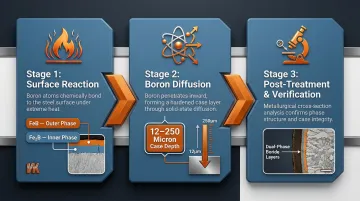
Step 1: Surface Reaction
The first phase involves a reaction between the boron-yielding compound and the part surface, driven by temperature. This creates a thin, dense initial boride layer composed of two distinct phases:
- Outer FeB phase: Harder but more brittle
- Inner Fe₂B phase: Slightly softer but more ductile and better bonded to the substrate
The ratio and thickness of these phases depend on material composition, temperature, and time.
Step 2: Boron Diffusion
Once the surface reaction establishes the initial boride layer, boron atoms migrate deeper into the metal substrate. Case depth grows as a function of time, temperature, and base metal chemistry. Typical boride case depths range from 12 to 250 microns. Higher alloy content in the base metal reduces diffusion rate and must be accounted for in process planning.
Step 3: Post-Treatment and Verification
After the thermal cycle, parts are removed and cooled. Case depth and phase composition are then verified through metallurgical cross-section analysis, with optional subsequent heat treatment applied for dimensional control or substrate property adjustment.
Because the boride case is extremely hard, post-treatment machining is largely impractical. Dimensional tolerances and final geometry must be planned before the part enters the process.
VaporKote formulates on-site powder mixes calibrated to each base metal's composition, producing a boride layer optimized for either maximum hardness or improved toughness depending on the application. Metallurgical analysis and certification are included with every job.
Industrial Applications of Boronizing
Boronizing is particularly suited to components exposed to abrasive particles, corrosive media, or both simultaneously.
Commonly treated components:
- Pumps (impellers, casings, wear rings)
- Valves (valve seats, stems, balls)
- Extrusion dies and screws
- Agricultural tillage and soil-engaging components (blades, shares, coulters)
- Drill bits and downhole tools
- Heat exchanger tubes
- Nozzles and molds
Why Boronizing Excels in These Applications
Boronizing is one of the few surface treatments that addresses abrasion resistance, erosion resistance, and corrosion resistance (including acid resistance) in a single treatment. This combination is critical in industries where components contact abrasive slurries, acidic process fluids, or high-temperature corrosive gases.
That breadth of protection translates directly into measurable results across several industries.
Industry-Specific Use Cases
Oil & Gas / Petrochemical: Pump and valve components exposed to corrosive hydrocarbons and abrasive particulates. Ultra-fast boriding of standard A36 carbon steel achieved equivalent corrosion and erosion resistance to Inconel 625 in geothermal brines, yielding an estimated 84% reduction in piping costs.
Mining: Crusher wear parts and conveyor components requiring extreme abrasion resistance. The ultra-hard surface (1500–2300 HV) provides carbide-like performance on standard steel substrates.
Agriculture: Soil-engaging tools where abrasive wear is the dominant failure mode. Field tests of AISI 1050 plowshares borided at 875°C showed a 24-fold increase in wear resistance compared to untreated steel.
Aerospace: Actuators and structural wear interfaces requiring lightweight treatment with exceptional hardness and dimensional stability.
Pulp & Paper: Screw conveyors and refiner plates exposed to corrosive chemical pulping environments.
Lifecycle Cost Context
These industry results point to a consistent pattern: boronizing is a one-time pre-service treatment, yet treated parts routinely outlast untreated counterparts by two to five times. That gap directly reduces cost-per-service-hour.
Key lifecycle data:
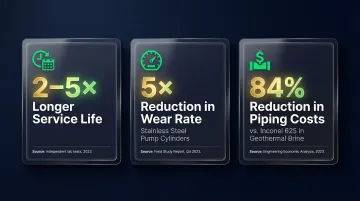
- 2–5x longer service life compared to untreated components across most applications
- 5x reduction in wear rate for boronized 17-4PH stainless steel fluid pump cylinders, per published case study
- 84% estimated reduction in piping costs when borided A36 steel replaced Inconel 625 in geothermal brine service
For large industrial parts — pump casings, valve bodies, heavy agricultural equipment — VaporKote's furnaces process components up to 68 inches in diameter, covering the oversized geometries common in petrochemical, mining, and heat exchanger applications.
Key Factors That Affect Boronizing Outcomes
Several variables determine whether a boronizing treatment delivers the case depth, phase balance, and service life a part requires. Understanding these factors upfront prevents costly failures downstream.
Base material chemistry shapes how fast and deep boron diffuses. Carbon steel responds fastest; chromium, nickel, and molybdenum alloys slow diffusion and reduce case depth. Stainless steels and nickel superalloys require extended treatment times or specialized conditions.
Temperature and time are the primary controls for case depth. Higher temperatures and longer cycles produce deeper cases, but also increase the risk of forming brittle FeB phase—precise control of both is essential.
Part geometry and surface prep directly affect uniformity. Blind holes, tight internal features, or large mass variations cause uneven case development. Oxides, oils, or prior coatings block boron diffusion and must be fully removed before treatment.
Phase composition matters most for impact-loaded parts. For components like agricultural blades or drill parts that face both wear and impact, a predominantly Fe₂B layer is the target—it is far more impact-resistant than FeB. Achieving this requires careful management of temperature and atmosphere.
Post-treatment handling requires care. The boride case cannot be practically machined after treatment, so all grinding and finishing must be completed beforehand. The extreme surface hardness also makes parts vulnerable to chipping from impact during assembly.
Common Misconceptions and Limitations of Boronizing
The Biggest Misconception
Boronizing is frequently confused with applying a boron-containing coating or plating. Boronizing is a diffusion process—the boride layer grows within the metal surface itself, not deposited on top of it. This means there is no risk of delamination, no coating thickness added to critical dimensions (beyond the case growth), and no mechanical interface that can fail.
When Boronizing Is Not the Right Choice
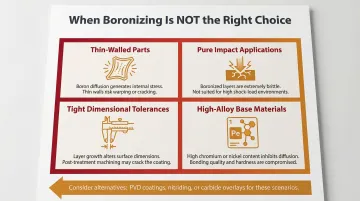
Four scenarios consistently argue against boronizing:
- Thin-walled parts: Thermal cycling can cause distortion or complete through-hardening, eliminating the ductile core needed to absorb impact loads.
- Pure impact applications: The hardness of FeB becomes a liability when shock loading dominates over abrasion. Carburizing is the better choice for heavily loaded gear teeth under transverse loading.
- Tight dimensional tolerances: Boriding causes dimensional growth equal to 5–25% of the layer thickness—a 25 µm case adds 1.25–6.25 µm to part dimensions. Post-treatment correction requires expensive diamond lapping, since conventional grinding fractures the boride layer.
- High-alloy base materials: Chromium-, nickel-, or molybdenum-rich alloys resist boron diffusion. High-alloy steels are typically limited to 25–76 µm case depths, compared to 50–250 µm achievable in low-carbon steels.
Avoiding Over-Application
Boronizing is sometimes specified by default for any wear application when nitriding or chrome plating would be fully sufficient at lower cost. The process earns its place where multiple failure modes—abrasion, corrosion, and friction—act simultaneously, or where service life demands exceed what standard treatments can realistically deliver. When only one failure mode is present and part geometry is complex, a simpler treatment is almost always the better engineering decision.
Frequently Asked Questions
What is the process of boronization?
Boronizing is a thermochemical diffusion process in which a metal part is heated in a boron-rich environment (pack powder, paste, or chemical vapor), causing boron atoms to diffuse into the surface and chemically bond with the base metal to form a hard boride case layer—without any coating or mechanical interface.
What metals can be boronized?
Nearly any ferrous material (carbon and alloy steels) can be boronized, as well as many nickel, cobalt, and titanium alloys. The higher the alloy element content of the base metal, the slower the diffusion rate and the thinner the achievable case depth.
How does boronizing compare to nitriding or carburizing?
Boronizing produces significantly harder surface layers (1500–2300 HV vs. 600–900 HV for nitriding) and offers better acid and corrosion resistance, making it suited for harsher wear, acid exposure, and elevated temperatures. Nitriding and carburizing remain viable for less severe applications where impact toughness takes priority.
How thick is the boride case layer after treatment?
Typical boride case depths range from approximately 12 to 250 microns, depending on base metal composition, treatment temperature, and treatment time. The exact case depth is specified based on the wear environment and the wall thickness of the component.
Can boronized parts be machined after treatment?
Due to the extreme surface hardness of the boride layer (equivalent to RC75+, harder than most cutting tool materials), conventional machining after boronizing is impractical. All dimensional finishing must be completed before treatment, and components should be designed with this constraint in mind.
Is boronizing a one-time or recurring treatment?
Boronizing is typically applied once before a component enters service. Because the boride case is consumed by wear over time, heavily worn parts can sometimes be re-treated—but boronizing is designed as a one-time treatment for long-term service life extension, not a recurring maintenance step.