Introduction
PVD coating quotes can vary by 300% or more for the same part—and manufacturers routinely get final invoices that bear little resemblance to their initial estimates. The process is applied across tooling, aerospace, medical devices, and industrial manufacturing, but pricing depends heavily on application, part geometry, batch size, and coating type.
Misunderstanding PVD coating costs leads to underbudgeting, choosing the wrong coating type, or missing the long-term value entirely. Buyers who chase the lowest per-part quote frequently pay more over the component's lifecycle through premature failure, increased maintenance frequency, or unplanned downtime.
This guide breaks down typical PVD coating price ranges, the key cost drivers, what a full cost picture looks like, and how to budget for your specific application.
TLDR
- Outsourced PVD coating typically costs $5–$50+ per part based on coating type, part size, and batch volume
- In-house systems can bring per-part costs below $5 at scale, but require significant upfront investment
- Batch volume is the single largest lever on per-part cost; fixed setup and chamber costs spread across every part in a run
- Lowest upfront price rarely equals best value—durability and maintenance savings matter over a component's full lifecycle
- Coating material (TiN vs. CrN vs. DLC) and part geometry both significantly affect final pricing
How Much Does PVD Coating Cost?
PVD coating has no fixed price. Costs depend on whether you're outsourcing to a service provider or running in-house equipment, plus part size, batch volume, coating type, and application requirements.
When buyers misread the cost structure, they underbudget for complex geometries, miss minimum lot fees on small runs, or select an inadequate coating tier — leading to early part failure and re-coating expenses.
Outsourced PVD Coating Service Costs (Per Part or Per Batch)
Outsourced PVD coating pricing varies widely:
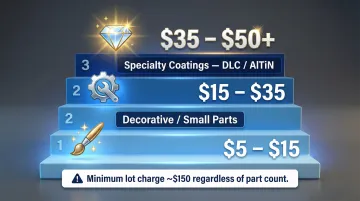
- Decorative/small parts: $5–$15 per part for standard TiN or CrN coatings on small components
- Standard industrial tooling: $15–$35 per part for cutting tools, wear components, or precision parts
- Specialty coatings (DLC, AlTiN, multilayer): $35–$50+ per part for premium coatings requiring complex processes
Most commercial service providers enforce minimum lot charges (typically $150) regardless of part count. AB Prototype's standard minimums illustrate this industry practice—small runs carry a premium because fixed chamber costs must be covered even for single-part orders.
What's typically included:
- Coating application
- Basic cleaning and pre-treatment
- Standard certification documentation
What's often excluded:
- Pre-coating surface finishing (polishing, grinding)
- Masking for tight-tolerance areas
- Expedite fees for rush orders
- Freight and return shipping
- Advanced metallurgical testing beyond standard specs
Lead times range widely: industrial coaters may offer 3–5 day turnarounds, while smaller shops run 8–12 weeks depending on capacity and coating complexity.
In-House PVD Coating System Costs
Purchasing a PVD coating system shifts costs from per-part service fees to capital equipment investment plus ongoing operating costs. Once volume justifies the equipment investment, per-part costs can drop by 60–80% compared to outsourced rates.
Equipment investment ranges:
- Used lab-scale systems: $8,500–$15,000 (suitable for R&D or very low volume)
- Used industrial batch systems: $108,000–$248,000 for production-scale equipment (sourced from European market listings)
- New industrial systems: $200,000–$500,000+ depending on chamber size and automation
In-house cost per part: At high batch volumes, per-part costs can fall to $0.09–$0.15 for 6-inch parts, according to VaporTech's batch processing model. The driver is chamber density — a large system processing 256 parts per batch costs only $8 more per run than a small system handling 96 parts, cutting per-part cost by 40%.
Critical requirements for in-house operations:
- Trained staff for equipment operation and maintenance
- Ongoing consumable budgets (target materials, process gases)
- Periodic chamber cleaning and component replacement
- Facility infrastructure (electrical capacity, ventilation)
Key Factors That Affect PVD Coating Cost
PVD coating pricing is shaped by a combination of technical, material, and operational variables. Understanding each one helps you compare quotes accurately and avoid unexpected costs.
Coating Material and Type
The choice of coating material directly affects cost:
Standard nitrides:
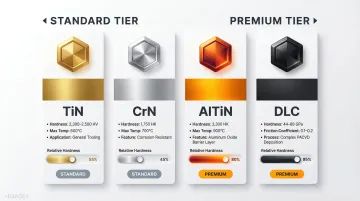
- TiN (Titanium Nitride): 2,300–2,500 HV hardness, stable to 500–600°C, ideal for general-purpose tooling
- CrN (Chromium Nitride): 1,750 HK hardness, excellent ductility and corrosion resistance up to 700°C
Premium coatings:
- AlTiN/TiAlN: 3,300 HK hardness, forms protective aluminum oxide layer, stable to 900°C for high-speed machining
- DLC (Diamond-Like Carbon): >2,000 HK to 44–68 GPa for advanced variants, ultra-low friction (0.1–0.2 coefficient), requires complex PACVD processes
Premium coatings cost more due to expensive target materials, longer deposition cycles, and process complexity. TiAlN targets sourced from European suppliers can cost €99–€166 each, while standard titanium targets run $90–$336 depending on size and purity.
Part Size, Geometry, and Batch Volume
Geometry complexity: PVD is a strict line-of-sight process—material travels in straight paths from source to substrate. Deep cavities and blind holes create shadowing effects. As a rule, the opening diameter must exceed the depth for adequate coating adhesion. Complex 3D parts require planetary rotation and multi-axis racking, reducing batch capacity and increasing setup costs.
Economies of scale: Fixed setup and chamber costs are distributed across every part in a batch. Cycle times are fixed (typically 1–3 hours) regardless of chamber fullness. Maximizing parts per rack drops per-unit pricing dramatically. Large batch runs are far more cost-effective than small custom jobs for exactly this reason.
Substrate Material and Pre-Coating Preparation
The base material affects both preparation requirements and coating adhesion. Parts submitted for PVD coating must meet specific surface conditions:
- Metallically bright, 100% stripped of prior coatings
- Free of oils, rust, and grinding burrs
- Pre-treated with additional surface finishing if substrate condition requires it
- Adjusted process parameters for harder or more reactive base materials
Each additional preparation step adds labor and processing cost.
Coating Thickness and Specification Requirements
Typical industrial PVD coatings range 0.5–5 µm thickness. Thicker coatings require longer deposition cycles and more material, increasing cost. Applications requiring tight thickness tolerances, metallurgical certification, or compliance with engineering standards (ASTM C1624 for adhesion, ASTM B568 for XRF thickness) add process overhead and documentation costs.
Full Cost Breakdown: What You're Actually Paying For
The true cost of PVD coating goes well beyond the quoted price per part—buyers need to account for the full cost picture to make accurate comparisons.
Initial/Setup Costs (One-Time):
- Outsourced: Tooling, fixture design, first-article qualification
- In-house: Capital equipment ($108,000–$500,000+), facility preparation, electrical infrastructure
Per-Batch Operating Costs (Recurring):
- Target materials: Titanium ($90–$336), chromium ($95), TiAl (approx. $108–$183)
- Process gases: Nitrogen and argon
- Electricity: Industrial systems draw massive loads (e.g., 66 kW for Hauzer Flexicoat 1500)
Pre- and Post-Processing Costs (Variable):
- Surface preparation (polishing, cleaning, masking)
- Post-coating inspection and certification
- Often excluded from quoted prices — but they're real costs that add up
These line items rarely appear in a supplier's initial quote. Getting a full cost picture means asking specifically about prep and inspection requirements upfront.
Maintenance and Replacement (Periodic):
- In-house systems: Chamber cleaning, component replacement, annual service contracts
- Outsourced: Lead times and freight costs that can disrupt production schedules
Low-Cost vs. High-Cost PVD Coating: What's the Real Difference?
The price gap between budget and premium PVD coatings isn't arbitrary — it maps directly to differences in process complexity, coating performance, and how long a part actually lasts in service.
Core trade-offs:
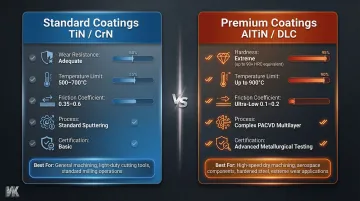
| Dimension | Low-Cost TiN/CrN | Premium AlTiN/DLC |
|---|---|---|
| Wear resistance | Adequate for general tooling | Extreme hardness for demanding applications |
| Temperature stability | 500–700°C | 900°C (AlTiN) / 300–500°C (DLC) |
| Friction properties | 0.35–0.6 coefficient | 0.1–0.2 ultra-low friction (DLC) |
| Process complexity | Standard sputtering | Complex PACVD, multilayer systems |
| Adhesion consistency | Good with proper prep | Requires support layers, precise control |
| Compliance documentation | Basic certification | Advanced metallurgical testing |
When to choose each:
- Lower-cost TiN coatings work well for decorative finishes and low-stress applications where extreme hardness isn't required
- Industrial tooling, precision components, or high-temperature environments typically justify the premium — extended service life drives better ROI per machined part
- High-friction or abrasive conditions (aluminum machining, hard turning) make DLC or AlTiN the practical choice, not just the premium one
The right way to evaluate these cost differences is per machined part, not per coated tool. Calculating it that way, the numbers shift considerably: AlTiSiN coatings improve tool life by 47.83% in hard turning applications, and DLC reduces wear rates by 85% in aluminum machining. Those gains routinely outweigh the upfront cost premium.
How to Estimate the Right Budget for PVD Coating
The goal isn't to find the cheapest coating—it's to find the one that delivers the best value for your specific operating conditions, component lifecycle expectations, and total cost of ownership.
Key budgeting considerations:
- Application and operating environment: Temperature, abrasion, corrosion exposure dictate minimum coating requirements
- Part volume and consistency needs: Batch size is the largest cost lever—consolidate runs to reduce per-part pricing
- Quality and compliance requirements: Engineering code adherence (ASTM, ASME, SAE, API) adds documentation costs but ensures performance
- Total lifecycle cost: Longer-lasting coatings reduce downtime, replacement frequency, and maintenance labor
For operations in oil & gas, petrochemical, mining, or aerospace, the budgeting process should start with a more fundamental question: is PVD the right coating class for your environment at all?
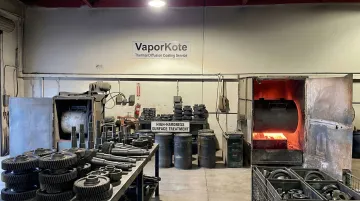
In extreme wear or high-corrosion applications, diffusion coating processes — boronizing and aluminizing — often outperform PVD on both hardness and long-term durability. VaporKote's thermal diffusion coatings reach RC75+ surface hardness (exceeding tungsten carbide cutting tools), which translates directly into fewer replacements and lower maintenance costs over the component's service life.
What Most Buyers Get Wrong About PVD Coating Costs
Common costly mistakes:
- Quoted per-part price omits batch minimums, setup fees, and turnaround time — compare total order cost, not just unit cost
- Re-coating frequency and downtime from early part failure routinely exceed whatever was saved on the initial coating
- A $10 TiN coating that fails in six months costs more over three years than a $35 AlTiN coating that lasts the full term
- Premium coatings on low-demand applications inflate costs without adding performance — standard options often do the job
- Deep recesses and complex geometries require multi-axis fixturing, which raises per-part cost and shrinks batch capacity
The right decision balances upfront cost, coating performance, and total cost of ownership. A higher-priced coating often delivers lower cost per service hour once re-coating intervals and downtime are factored in. Work with a coating provider who can back their recommendation with application data — not just a price sheet.
Frequently Asked Questions
How much does PVD coating cost?
Outsourced PVD coating typically ranges from $5 to $50+ per part depending on part size, coating type (TiN vs. DLC), and batch volume. In-house systems can lower per-part cost to $0.09–$0.15 at scale but require significant capital investment ($108,000–$500,000+). For application-specific pricing, request quotes from service providers or contact VaporKote at (714) 632-8607.
What factors affect PVD coating prices the most?
The top drivers are coating material type (standard TiN vs. premium DLC), part geometry and complexity (simple vs. deep cavities), batch size (economies of scale), and whether coating is outsourced or done in-house. Batch volume is often the single largest lever on per-part cost because fixed chamber costs are distributed across more parts in larger runs.
Is PVD coating worth the cost?
For most industrial and tooling applications, yes. PVD coating extends component life, reduces wear-related downtime, and lowers maintenance costs across the full lifecycle. Studies show tool life improvements of 47.83% with AlTiN coatings and 85% wear reduction with DLC—strong returns even against higher upfront cost.
How does PVD coating cost compare to other surface treatments?
PVD costs more upfront than electroplating or heat treatment but offers superior hardness and cleaner processing with no toxic chemicals. Hard chrome plating reaches 1,210 HV but faces environmental restrictions; AlTiN PVD coatings reach 3,300 HK. In extreme wear or corrosion environments, diffusion coatings like boronizing can match or exceed PVD performance at competitive lifecycle costs.
Can I reduce PVD coating costs by ordering larger batches?
Yes—batch size is one of the most direct levers for reducing per-part PVD coating cost. Fixed setup and chamber costs are distributed across every part in a run, so consolidating production runs can drop per-part pricing by 40% or more. Coordinate with your provider to maximize chamber density on each run for the best per-part rate.
How long does PVD coating last?
Lifespan depends on the application, coating type, and operating conditions. In demanding industrial environments, coated cutting tools commonly achieve three times longer tool life per edge, directly cutting cost per machined part. Wear and corrosion-resistant coatings like DLC and AlTiN show similarly strong durability in high-load applications.