According to NACE International's IMPACT study, global corrosion costs reach $2.5 trillion annually — roughly 3.4% of global GDP. Effective corrosion-control practices could save between $375 billion and $875 billion of that every year. Add unplanned downtime to the picture, and the stakes become even clearer: Siemens' 2024 analysis found that the world's 500 largest companies lose $1.4 trillion annually to unplanned downtime, averaging 27 hours per month per large plant.
Surface treatment is the front line of defense against these losses. This guide covers what surface treatment actually means, the four main categories of methods, how to choose the right approach for your application, and why diffusion coatings stand apart for the most demanding industrial environments.
Key Takeaways
- Surface treatment modifies a material's outer layer, targeting hardness, corrosion resistance, or adhesion, without altering the bulk material
- The four main categories are mechanical, chemical, thermal/heat treatment, and diffusion coating
- Choosing the right method depends on base material, operating environment, performance requirements, and total cost of ownership
- Diffusion coatings like boronizing and aluminizing consistently outperform conventional treatments in high-wear, high-temperature, or chemically aggressive environments
- VaporKote has applied diffusion coatings for oil & gas, petrochemical, mining, and aerospace components since 1987
What Is Surface Treatment?
Surface treatment refers to any physical, chemical, or thermal process applied to the outermost layer of a material to modify its properties — hardness, corrosion resistance, adhesion, wear resistance, or appearance — without necessarily changing the bulk material.
Surface engineering treats the surface and near-surface regions so that the surface can perform functions different from those required of the core material — a concept well established by ASM International. The substrate and the surface work together as a system; failure of the surface means failure of the whole component.
Two Fundamental Process Directions
Surface treatment methods fall into two broad categories:
- Removal processes — blasting, etching, grinding, and similar methods that strip contaminants, scale, or material from the surface to clean, prepare, or reshape it
- Additive processes — plating, coating, thermal diffusion, and deposition techniques that deposit or bond new material to the surface to build up a protective or functional layer
Why Not All Surface Treatments Are Coatings
Coating is one type of surface treatment — but not all surface treatments are coatings. Heat treatment alters the microstructure of the metal without depositing any external layer. Diffusion processes bond elements into the base metal at a molecular level. Mechanical finishing changes surface texture without adding material.
This distinction matters when specifying treatments. The sections below break down each major category — removal, additive, and diffusion-based — so you can match the right method to what your surface actually requires.
Why Surface Treatment Matters for Industrial Components
Untreated metal components are vulnerable from the moment they enter service. Oxidation, abrasive wear, chemical attack, and fatigue cycling all degrade surfaces over time — and in industries like oil & gas, mining, or petrochemical processing, that degradation happens fast.
The downstream consequences are predictable: component failure, unplanned shutdowns, safety exposure, and replacement costs that compound quickly when the part in question sits inside a pump, heat exchanger, or drilling assembly.
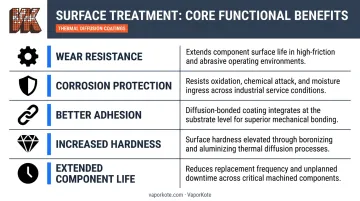
Five Core Functional Benefits
The right surface treatment addresses these vulnerabilities directly:
| Benefit | Operational Outcome |
|---|---|
| Improved wear resistance | Longer service intervals for pumps, valves, and rotating equipment |
| Enhanced corrosion protection | Reduced replacement frequency in chemically aggressive or high-temperature environments |
| Better adhesion | Stronger bond for subsequent coatings or bonded assemblies |
| Increased surface hardness | Resistance to abrasive media and impact damage |
| Extended component life | Lower total cost of ownership across the equipment lifecycle |
Surface treatment also changes the materials economics calculation. A standard steel component with a properly applied diffusion coating can outperform a more costly alloy substrate in the same environment — eliminating the need for expensive exotic base materials entirely. The coating carries the performance burden; the substrate simply provides structural support.
Main Types of Surface Treatment Methods
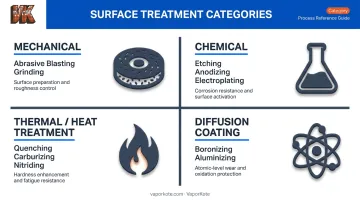
Most industrial applications require selecting from — or sequencing — four major categories: mechanical, chemical, thermal/heat treatment, and diffusion coating. The right category depends on material type, performance targets, and operating environment.
Mechanical Surface Treatments
Mechanical methods include abrasive blasting (sandblasting, shot blasting), grinding, and barrel finishing or de-burring. These processes clean, reshape, and texture metal surfaces through physical abrasion.
Primary applications:
- Removing scale, rust, mill oxides, and surface contamination
- Creating surface texture (anchor profile) that improves adhesion for subsequent coatings
- De-burring and edge finishing on machined components
AMPP and ASTM standards for blast cleaning define these processes as preparation steps before applying a protective coating or lining — not as standalone corrosion barriers. Mechanical treatments are low-cost and widely used, but they typically serve as pre-treatment rather than a final protective solution.
Chemical Surface Treatments
Chemical methods use chemical or electrochemical reactions to clean, convert, or build up the surface. Common processes include:
- Chemical etching — removes oxide layers and prepares surfaces for bonding
- Vapor degreasing — removes oils and contaminants before coating
- Anodizing — builds an oxide layer on aluminum for corrosion and wear resistance
- Electroplating / e-coating — deposits a metallic film through electrochemical action
These methods offer precision and repeatability. Limitations include chemical waste generation, tight process controls, and material compatibility constraints. The EPA's Metal Finishing Effluent Guidelines regulate roughly 44,000 facilities conducting metal finishing operations, covering electroplating, anodizing, and chemical etching — compliance overhead is a real cost factor.
Thermal and Heat-Based Treatments
Thermal treatments alter the microstructure of the metal surface through controlled heating and rapid cooling cycles. Key processes include:
- Surface quenching — rapid cooling to harden the outer layer while preserving a tougher core
- Carburizing — introduces carbon into the surface layer at elevated temperature, increasing hardness and fatigue resistance
- Nitriding — diffuses nitrogen into the surface to build hardness and wear resistance without distortion
Nitriding is well-suited for gear teeth and load-bearing surfaces — with good process controls, Nitralloy 135M can achieve 60 to 62 HRC surface hardness, a key benchmark for applications where tooth wear and fatigue drive failure.
Diffusion Coating Processes
Diffusion coatings — including boronizing (boriding), aluminizing, and chromizing — represent a distinct category. Rather than depositing a layer on top of the surface, these processes thermally diffuse reactive elements into the base metal to form an intermetallic compound.
The coating becomes a metallurgical bond, integrated into the base material rather than sitting on top of it. That structural difference is why diffusion coatings perform differently under load, at high temperatures, and in corrosive environments compared to electroplated or mechanically applied alternatives. This category is covered in depth in the next section.
How to Choose the Right Surface Treatment Method
Four evaluation criteria consistently determine whether a surface treatment performs through its service life — or fails prematurely. Getting each one right before you specify a process saves significant rework downstream.
Material Compatibility
The base material drives feasibility. Some treatments are exclusive to ferrous metals; others are optimized for aluminum, titanium, or nickel-based alloys. Applying a mismatched process risks surface damage, inadequate bonding, or compromised base material properties.
Check compatibility against published specifications — ASTM B733-22, for example, defines requirements for electroless nickel-phosphorus coatings, including acceptance criteria for appearance, thickness, adhesion, and porosity by service condition class.
Once material compatibility is confirmed, the next question is what the coating actually needs to do.
Performance Requirements
Before specifying a treatment, answer these questions:
- What surface hardness is required for the application?
- What corrosion environment will the part face — acidic, saline, high-temperature oxidation?
- Is wear resistance, erosion protection, or adhesion the primary need?
- What fatigue loading does the component experience?
ASTM, ASME, SAE, and API standards provide published minimum performance thresholds for different service conditions. Using these frameworks to specify treatments removes ambiguity and gives engineers a defensible basis for selection.
Performance requirements and operating environment are closely linked — the same conditions that demand high hardness often impose thermal constraints too.
Operating Environment and Temperature Range
This criterion eliminates a lot of options quickly. Conventional paints, organic coatings, and many electroplated finishes degrade at elevated temperatures. Components in furnaces, process heaters, engine assemblies, or downhole environments need treatments that maintain integrity under heat.
Diffusion coatings and ceramic-based treatments are engineered for this — they're thermochemically stable at the temperatures where conventional treatments fail.
Total Cost of Ownership vs. Upfront Cost
A cheaper mechanical treatment requiring re-application every six months rarely beats a premium diffusion coating that lasts the component's service life. The Federal Highway Administration has documented life-cycle cost savings from metallized coatings in infrastructure applications despite higher upfront costs. The same math applies to industrial components: calculate total ownership cost, not purchase price alone.
Evaluate treatment cost in the context of:
- Replacement frequency and how often the part must come offline for re-treatment
- Labor and downtime costs incurred each time a component is pulled from service
- Consequences of in-service failure, including equipment damage, safety risk, and lost production
Diffusion Coating: A High-Performance Surface Treatment for Demanding Environments
Diffusion coating is a chemical vapor deposition (CVD) process. Reactive gases carry elements — boron, aluminum — into a heated base metal surface, where they diffuse into the material and form a dense intermetallic compound. The coating doesn't sit on top; it becomes part of the metal's near-surface structure.
VaporKote describes this as a "synergistic blend of base metal and coating" — and the description is technically accurate. The intermetallic layer cannot delaminate because it isn't adhered; it's integrated.
Performance Characteristics
The hardness numbers from diffusion coatings are notable. Research on boronized EN-C35E steel measured boride layer hardness at 1,895 to 2,143 HK0.05 — roughly eight times the substrate hardness. Layer thickness ranged from 25 to 167 micrometers depending on process time and temperature.
An MDPI Coatings study on boronized, aluminized, and chromized steels in simulated high-temperature recovery boiler conditions found boronized coatings delivered 3 to 10 times longer service life than uncoated steels.
Separately, research on iron boride coatings on carbon steel confirmed significantly higher abrasion and erosion-abrasion-corrosion performance than bare carbon steel under conditions simulating downhole oil production.
Boronizing vs. Aluminizing: Different Problems, Same Process Category
VaporKote offers both as distinct services with different primary targets:
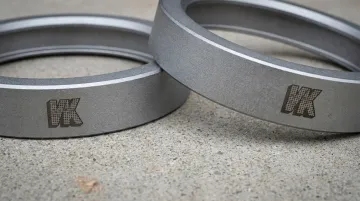
- Boronizing — targets wear and erosion resistance; VaporKote's process achieves 1,500 Knoop hardness (RC75+ equivalency), harder than tungsten carbide cutting tools
- Common applications: pump wear rings, impellers, valve components, nozzles in abrasive service
- Aluminizing — targets high-temperature corrosion and oxidation protection in thermal cycling environments
- Common applications: heat exchanger tubing, fasteners, reactor screens
Where Diffusion Coatings Are the Right Answer
These environments consistently push conventional treatments past their performance envelope:
- Petrochemical processing equipment handling corrosive process streams
- Oil drilling and production components exposed to abrasive and erosive fluids
- Mining equipment subject to combined wear and chemical attack
- Heat exchangers in high-temperature service
- Aerospace components on nickel superalloy substrates (aluminide coatings on IN 718 have been extensively studied for this application)
VaporKote has served these sectors since 1987. For each project, the company formulates powder mixes on-site — enabling application-specific tuning rather than relying on standardized off-the-shelf processes.
Furnaces handle components up to 68 inches in diameter, and all work adheres to ASTM, ASME, SAE, and API engineering standards. Metallurgical analysis and certification are provided for every treated component.
Surface Treatment Applications Across Key Industries
Different industries lean on different treatment categories based on operating conditions:
| Industry | Primary Treatment Types |
|---|---|
| Oil & gas / petrochemical | Diffusion coatings, thermal hardening, chemical-resistant linings |
| Mining | Diffusion coatings, hard chrome alternatives, thermal hardening |
| Aerospace | Aluminide diffusion coatings, anodizing, PVD coatings |
| Automotive | Carburizing, nitriding, electroplating |
| Electronics / medical devices | Chemical cleaning, anodizing, precision plating |
| Heat exchanger manufacturing | Aluminizing, thermal spray, chemical-resistant coatings |
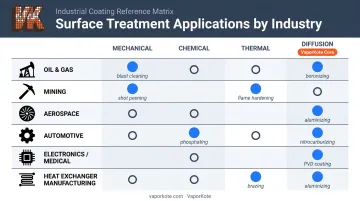
Heavy-duty industrial sectors rarely rely on a single treatment. Preparation (mechanical or chemical cleaning) typically precedes protection (thermal hardening or diffusion coating) — the two stages work together.
NACE's IMPACT study attributed $1,446.7 billion of global corrosion cost to the industrial sector alone. That figure represents real maintenance budgets, replacement cycles, and production downtime — costs that drop significantly when treatments are specified to match the actual operating environment.
Frequently Asked Questions
What is the meaning of surface treatment?
Surface treatment refers to any process applied to a material's outer layer to modify its physical, chemical, or mechanical properties (hardness, corrosion resistance, adhesion) without altering the core material. The surface and substrate function together as a system.
What types of surface treatments are there?
The four main categories are:
- Mechanical: blasting, grinding
- Chemical: etching, anodizing, electroplating
- Thermal/heat treatment: quenching, carburizing, nitriding
- Diffusion/coating: boronizing, aluminizing, CVD coatings
Most demanding applications combine methods from multiple categories.
Is surface treatment the same as coating?
No. Coating is one type of surface treatment, but heat treatment, diffusion processes, and mechanical finishing all modify the surface without necessarily applying an external layer. Not all surface treatments involve depositing new material onto the component.
How do I choose the right surface treatment for my application?
Evaluate base material compatibility, operating environment (temperature, chemical exposure, wear conditions), required performance properties, and total cost of ownership. Reference ASTM, ASME, SAE, or API standards for specification guidance. Prioritize lifecycle cost over upfront treatment cost.
What is the difference between diffusion coating and electroplating?
Electroplating deposits a metallic layer onto the surface via electrochemical action. Diffusion coating thermally bonds elements into the base metal, forming an intermetallic compound that is integral to the material rather than adhered on top — making it far more resistant to delamination and better suited for elevated temperatures.
Which surface treatment provides the best wear and corrosion resistance?
For severe industrial environments, diffusion coatings (particularly boronizing and aluminizing) consistently deliver superior combined wear and corrosion resistance, especially at elevated temperatures where conventional coatings degrade. Boride layers on steel have demonstrated hardness approximately eight times that of the substrate.