Chemical vapor deposition (CVD) is one of the most effective answers to that problem. At its core, CVD introduces volatile chemical precursors as gases into a reaction chamber, where they react on a heated substrate surface and form a solid, high-quality coating — one that can penetrate complex geometries and bond chemically with the base material.
This article covers how CVD works step-by-step, the major process variants, how it compares to PVD, key advantages and limitations, and which industries rely on it most.
Key Takeaways
- CVD uses gas-phase chemical reactions to deposit solid, uniform coatings directly onto a substrate surface
- CVD coats complex geometries and internal cavities with consistent thickness, unlike line-of-sight deposition methods
- CVD variants — thermal, plasma-enhanced, and diffusion-based — each suit different materials and operating conditions
- Diffusion CVD processes like boronizing and aluminizing drive exceptional wear and corrosion resistance in heavy industrial sectors
- CVD differs from PVD fundamentally: CVD relies on chemical reactions at the substrate, not physical vaporization of a solid source
How Does Chemical Vapor Deposition Work?
The process starts with a substrate — the component to be coated — placed inside a sealed reaction chamber. One or more precursor gases are then introduced. These gases either react directly with the substrate surface or decompose into reactive species that deposit as a solid film.
Energy Sources: Heat vs. Plasma
Two primary energy mechanisms drive the reactions:
- Thermal CVD uses elevated substrate temperatures to initiate chemical reactions — effective for most industrial coatings but limited to substrates that can handle high heat
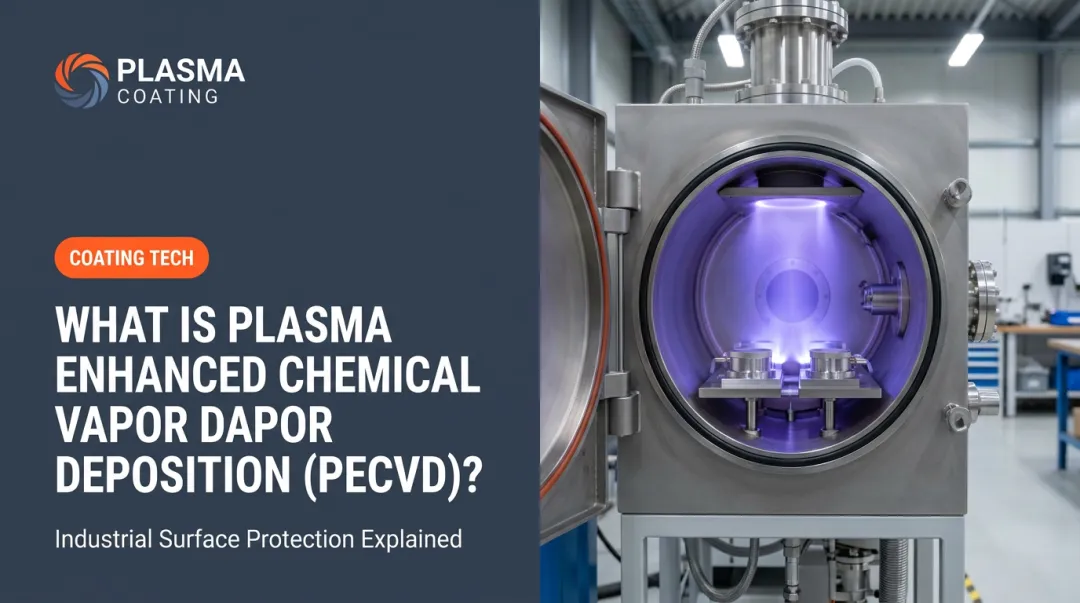
- Plasma-enhanced CVD (PECVD) uses ionized gas to trigger reactions at much lower temperatures, protecting heat-sensitive materials from thermal damage
The Sequential Steps
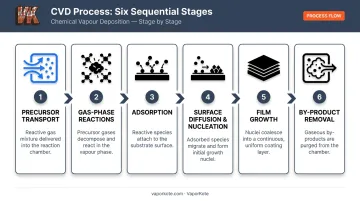
Every CVD process follows the same fundamental sequence:
- Precursor transport — gases flow into the chamber toward the substrate via convection and diffusion
- Gas-phase reactions — precursors undergo homogeneous reactions (occurring in the gas phase, not at the surface) before reaching the surface
- Adsorption — reactive species adsorb onto the substrate surface
- Surface diffusion and nucleation — adsorbed species migrate to growth sites and begin forming the film
- Film growth — successive surface reactions accumulate into a continuous solid coating
- By-product removal — volatile by-products desorb and are extracted through the exhaust system
Why CVD Coats Complex Shapes
Unlike physical vapor deposition, which deposits material in a straight line from source to target, CVD uses precursor gases that move in all directions simultaneously. These gases travel via intermolecular collisions into pores, trenches, recessed cavities, and spaces between woven fibers. The result: a conformal coating with consistent thickness across irregular geometries and internal passages that line-of-sight methods cannot reach.
That conformality doesn't happen automatically — it depends on tightly controlled process conditions. Engineers adjust four key variables to govern coating quality and composition:
| Variable | What It Controls |
|---|---|
| Temperature | Reaction rate, coating microstructure |
| Pressure | Film uniformity, gas-phase reaction extent |
| Gas flow rate | Precursor delivery, by-product removal |
| Precursor concentration | Coating composition, deposition rate |
Types of Chemical Vapor Deposition Processes
CVD is not a single process — it's a family of techniques differentiated by operating conditions, energy source, and precursor chemistry. The most industrially relevant variants are:
Thermal CVD (Atmospheric and Low-Pressure)
Thermal CVD is the foundational form. The substrate is heated inside a chamber and precursor gases decompose or react on its surface.
- Atmospheric pressure CVD (APCVD) prioritizes throughput and simpler pressure control
- Low-pressure CVD (LPCVD) reduces unwanted gas-phase reactions and improves film uniformity — the preferred choice for semiconductor thin films
Plasma-Enhanced CVD (PECVD)
PECVD replaces some thermal energy with plasma, allowing deposition at substrate temperatures below 150°C in many configurations. This makes it essential for semiconductor manufacturing and for any substrate that can't tolerate high heat. Dielectric layers like silicon oxides and silicon nitrides in integrated circuits are typically deposited this way.
Diffusion CVD: Boronizing and Aluminizing
Unlike surface-only coating methods, diffusion CVD drives reactive chemical species into the base metal, forming an intermetallic compound layer through a metallurgical bond. Because the coating is chemically integrated with the substrate rather than mechanically attached, delamination and peeling are not failure modes.
- Boronizing diffuses boron into metal surfaces, achieving hardness around 1500 Knoop — harder than tungsten carbide cutting tools, with high resistance to abrasion and erosion
- Aluminizing diffuses aluminum into the substrate to form intermetallic compounds with proven high-temperature oxidation and corrosion resistance
VaporKote's boronizing and aluminizing services are built on this diffusion mechanism, applied across oil production, petrochemical refining, aerospace, mining, and heat exchanger manufacturing since 1987.
Other Notable CVD Types
- MOCVD (Metal-Organic CVD) — uses metalorganic precursors like trimethylgallium to produce compound semiconductors and LEDs
- ALD (Atomic Layer Deposition) — sequential, self-limiting reactions enabling ultra-thin films with atomic-scale precision
- HFCVD (Hot Filament CVD) — uses a refractory filament heated to approximately 2,000–2,200°C to activate gas-phase species, commonly used for diamond-like carbon coatings
CVD vs. Physical Vapor Deposition: Key Differences
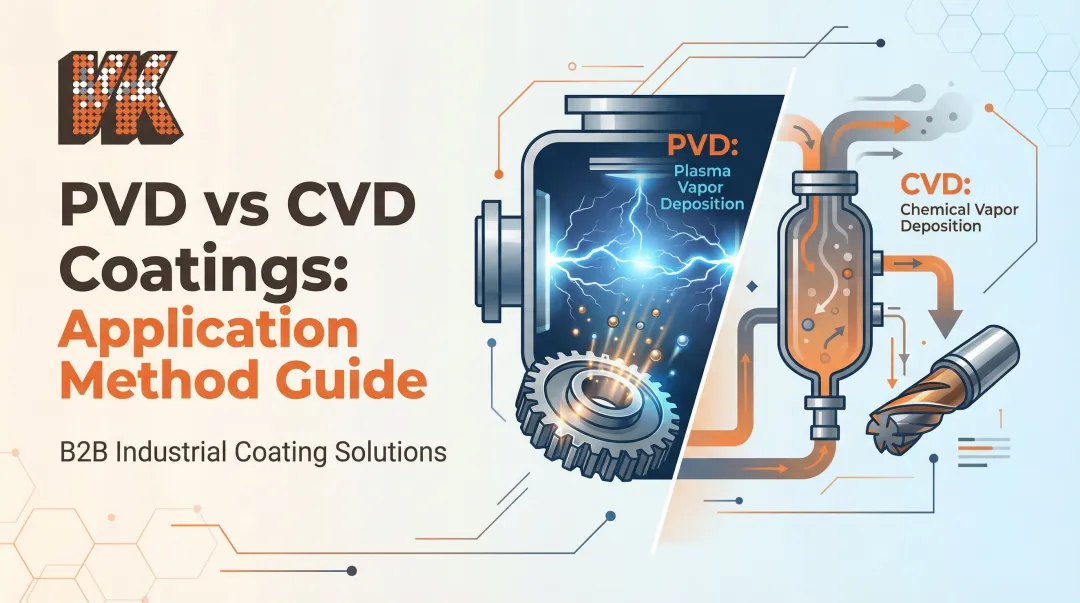
The distinction comes down to mechanism. CVD forms coatings through chemical reactions that occur at the substrate surface, creating chemical or metallurgical bonds between the coating and base material. PVD physically vaporizes a solid target into a plasma and deposits it via a line-of-sight path with no chemical reaction required.
| Factor | CVD | PVD |
|---|---|---|
| Mechanism | Chemical reaction at substrate | Physical transfer from vaporized source |
| Coating conformality | Excellent — coats recessed surfaces and complex geometries | Limited — line-of-sight deposition, uneven on complex profiles |
| Bond type | Chemical or metallurgical | Mechanical adhesion |
| Temperature | Varies widely; thermal CVD requires high heat | Generally lower thermal load on substrate |
| By-products | Toxic/hazardous gases require exhaust and handling controls | Simpler by-product management |
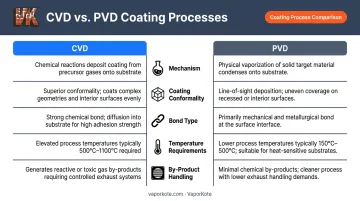
For industrial components with cavities, irregular profiles, or internal passages, CVD's conformality advantage is substantial. A 2020 peer-reviewed study of CVD TiN vs. PVD TiN on biomedical Co-Cr alloy found CVD coatings demonstrated superior adhesion in progressive scratch testing.
The choice depends on your constraints. PVD suits heat-sensitive substrates and situations where by-product handling is a practical limitation. For maximum surface hardness, chemical bonding strength, and consistent coverage across complex geometries, CVD diffusion processes are the more capable option.
Advantages and Limitations of Chemical Vapor Deposition
Advantages
CVD offers a distinct set of process advantages that make it the preferred choice for demanding industrial applications:
- Conformal coverage — gaseous precursors coat recessed surfaces, internal cavities, and complex geometries uniformly
- Strong adhesion — chemical or metallurgical bonding produces coatings that resist delamination under mechanical stress
- Extreme surface hardness — diffusion coatings like boronizing achieve 1500 Knoop (RC75+ equivalency), harder than tungsten carbide cutting tools
- Scalable batch processing — multiple components can be processed simultaneously, reducing per-unit cost on production runs
- Versatile coating materials — borides, aluminides, silicon carbide, titanium nitride, diamond-like carbon, and polymer films
Limitations
- Hazardous chemistry — many precursor gases (silane, dichlorosilane, silicon tetrachloride) are flammable or toxic, requiring specialized exhaust systems, gas detection, and regulatory compliance under EPA and OSHA frameworks
- High temperature requirements — thermal CVD can stress substrates through differential thermal expansion and limits which base materials are compatible
- Material costs — certain high-purity precursor gases, particularly metal-organic compounds, can significantly raise process costs
Industrial Applications of Chemical Vapor Deposition
Semiconductors and Electronics
CVD underpins modern semiconductor manufacturing. LPCVD deposits polysilicon and passivation layers; PECVD handles insulating dielectric films in integrated circuits; ALD provides conformal nanoscale films for advanced nodes. Grand View Research estimates the global CVD market at $26.3 billion in 2025, projected to reach $54.0 billion by 2033 — growth driven heavily by semiconductor demand.
Wear and Corrosion Protection for Industrial Equipment
Boronizing and aluminizing deliver documented performance gains for components operating in severe service environments. In oil production and mineral processing, iron boride coatings provide protection against sand erosion and erosion-corrosion in tubing components — peer-reviewed research confirms measurably higher resistance under abrasion and erosion-corrosion conditions compared to bare carbon steel.
VaporKote has applied diffusion coatings in these environments since 1987, serving industries including:
- Oil production and petrochemical refining
- Mining and mineral processing
- Pulp and paper manufacturing
- Agriculture and heat exchanger manufacturing
The company's metallurgically bonded coatings are certified through internal analysis adhering to ASTM, ASME, SAE, and API standards. The result is measurable: component life extensions that translate to hundreds of thousands of dollars in annual maintenance cost savings for customers.

Aerospace and High-Temperature Applications
CVD aluminide coatings protect turbine blades and hot-section engine components from high-temperature oxidation and hot corrosion. NASA research identifies high-temperature environmental attack as a direct threat to turbine efficiency and component life — aluminide diffusion coatings are central to managing that threat. A 2024 peer-reviewed study on yttrium-modified aluminide coatings produced by CVD confirmed strong high-temperature oxidation resistance on nickel-base superalloys.
Emerging Applications
CVD's reach extends well beyond metals and semiconductors:
- Graphene production — CVD is the most established method for synthesizing high-quality graphene at scale, with roll-to-roll production methods now achieving industrial output capacity
- Diamond-like carbon (DLC) — PECVD-deposited DLC coatings for cutting tools achieve hardness of 30–50 GPa with friction coefficients around 0.1, extending tool life in automotive and machining applications
- Polymer CVD — initiated and oxidative CVD polymerization methods produce designed polymer surfaces for packaging, biomedical implants, and optical components without liquid solvents
Frequently Asked Questions
What is chemical vapor deposition?
CVD is a thin-film deposition process in which volatile chemical precursors react or decompose on a heated substrate surface to form a solid, high-purity coating. It's used across industries ranging from semiconductor manufacturing to heavy industrial wear protection.
Which is better, CVD or PVD?
Neither is universally superior. CVD offers better conformality, chemical bonding, and extreme hardness for complex geometries and heavy industrial use. PVD operates at lower temperatures with simpler by-product handling and suits heat-sensitive substrates. Application requirements determine the right choice.
What is CVD in jewelry?
CVD diamonds are lab-grown gemstones produced by placing a diamond seed in a chamber with carbon-containing gas at approximately 900–1,200°C, where microwave energy causes carbon to precipitate from a plasma and crystallize on the seed.
What industries use CVD coatings?
Semiconductors, aerospace, oil and gas, petrochemical refining, mining, automotive, medical devices, and packaging all rely on CVD. Diffusion CVD coatings — boronizing and aluminizing — are particularly valued in heavy industrial sectors for wear and corrosion resistance.
What materials can be coated using CVD?
Common substrates include steels, superalloys, carbides, and silicon. Coating materials range from borides and aluminides to silicon carbide, titanium nitride, diamond-like carbon, and polymer films. The specific coating depends on required properties: hardness, corrosion resistance, or thermal stability.
How does CVD coating improve equipment lifespan?
Diffusion CVD coatings like boronizing form an intermetallic compound layer — not a surface film — that can reach up to 1,500 Knoop hardness, far exceeding standard surface treatments. Because the layer is metallurgically bonded to the substrate, it resists delamination and reduces wear rates — extending service intervals and lowering total maintenance costs.