Introduction
Modern manufacturing operates on razor-thin margins where a single component failure can cascade into six-figure losses. Rising operational complexity, stricter safety regulations, and zero tolerance for unplanned downtime have pushed precision from a design preference to a survival requirement—especially in aerospace, oil & gas, and mining, where the cost of failure extends far beyond replacement parts.
Precision is most often discussed in machining terms: tolerances, GD&T symbols, micron-level accuracy. But its real value emerges downstream—in how long equipment lasts under stress, how reliably it performs in harsh environments, and how much unplanned maintenance drains operational budgets.
A dimensionally perfect component that corrodes or wears out in six months hasn't delivered precision. It's delivered a scheduled replacement cost.
That gap between machined accuracy and long-term performance is where surface protection becomes critical. This article breaks down what high-precision components actually deliver in practice: measurable performance advantages, the compounding cost of overlooking precision, and how manufacturers protect that investment through surface treatments that preserve tolerances long after machining is complete.
Key Takeaways
- High-precision components maintain exact dimensional tolerances, ensuring consistent fit and performance across assemblies
- Even minor dimensional deviations can trigger system-wide failures — with serious safety and financial consequences
- Precision delivers enhanced reliability, reduced long-term costs, and stronger regulatory compliance
- Surface integrity determines how long precision holds under operating conditions
- Advanced coatings like boronizing extend the life of precision components and lower total cost of ownership
What Are High-Precision Components?
High-precision components are parts manufactured to extremely tight dimensional tolerances—often within thousandths of an inch—so they fit and function exactly as designed within a larger system. When a valve seat mates with a stem or a bearing fits a shaft, that interaction must happen with zero unintended variation.
Where precision matters most:
- Engine parts and turbine blade assemblies
- Valve bodies and pump internals
- Hydraulic fittings and sealing surfaces
- Aerospace structural elements
- Drilling equipment and downhole tools
- Agricultural machinery drives
Precision is a means to an end. A 0.001-inch tolerance exists to deliver system-level reliability, safety, and efficiency under real operating conditions—high loads, temperature swings, and corrosive fluids. A component that loses dimensional accuracy to wear or corrosion will eventually compromise the entire assembly around it. Maintaining that precision over a component's service life is just as critical as achieving it during manufacturing.
Key Advantages of High-Precision Components
The advantages below are grounded in operational outcomes—uptime percentages, maintenance spend, quality rates, and compliance exposure. These are the metrics plant managers and procurement teams track when justifying the premium for precision.
Enhanced System Performance and Reliability
Precision components are engineered to interact with mating parts without introducing slop, misalignment, or excessive friction. This means the whole assembly performs closer to its designed specification from day one, not after field adjustments or shimming.
How this shows up in operations:
- Smoother load transfer in rotating equipment reduces vibration
- Consistent flow dynamics in valve and pump systems maintain pressure
- Reduced vibration in high-speed assemblies extends bearing life
- Predictable wear behavior allows maintenance planning instead of reactive scrambling
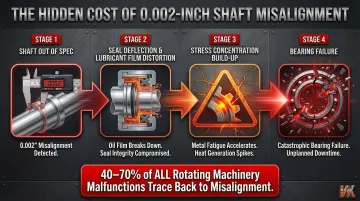
Poor-fit components force adjacent parts to compensate. A shaft that's 0.002 inches out of spec creates misalignment that deflects seals, distorts lubricating films, and introduces stress concentrations that weren't in the original design. Bearing failures account for 40–70% of rotating machinery malfunctions, with shaft misalignment recognized as a critical root cause.
In the petrochemical sector, API 610 standards strictly govern centrifugal pump clearances. For wear rings with a 2-inch diameter or less, the minimum diametral clearance is 0.010 inches, increasing by 0.001 inches for every 0.5-inch increase in outer diameter. If clearances are too small, wear rings make contact, leading to catastrophic failure. If too large, internal leakage reduces pump efficiency and output.
KPIs impacted:
- Mean time between failures (MTBF)
- Equipment uptime percentage
- Maintenance call frequency
- Product reject rates in downstream manufacturing
When this advantage matters most:
High-speed rotating equipment, high-pressure fluid systems, multi-component assemblies where tolerance stack-up is cumulative, and safety-critical applications in aerospace, defense, and medical sectors.
Reduced Long-Term Costs from Failures, Rework, and Downtime
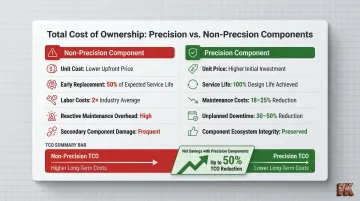
Those reliability gains translate directly into cost. Precision components carry a higher unit price, but they deliver measurable savings over their service life by reducing unplanned replacements, rework cycles, and emergency maintenance. A non-precision part may fit initially but wear unevenly, requiring replacement at half the expected service interval and doubling part spend, labor costs, and production disruption over time.
Beyond the part price:
The part price is only the beginning. Add labor to remove and replace it, lost production during downtime, potential secondary damage to connected components, and the management overhead of reactive maintenance programs. Unplanned downtime costs industrial manufacturers an estimated $50 billion annually, with average costs of $125,000 per hour. In oil & gas, downtime costs have more than doubled in recent years, reaching almost $500,000 per hour.
Total cost of ownership:
Manufacturers who track TCO rather than unit cost favor precision components for straightforward reasons: longer service intervals and fewer failure events change the financial picture entirely. Predictive maintenance strategies paired with precision components reduce overall maintenance costs by 18–25% and cut unplanned downtime by 30–50%.
KPIs impacted:
- Maintenance spend as a percentage of asset value
- Unplanned downtime hours
- Cost per unit produced
- Spare parts inventory carrying costs
When this advantage matters most:
Remote or difficult-to-access equipment where replacement is logistically expensive, high-volume production lines where any downtime is amplified, and operations with lean maintenance staffing where reactive work is disproportionately disruptive.
Compliance with Engineering Standards and Quality Traceability
In regulated industries, high-precision components aren't optional: they're required to meet engineering codes like ASTM, ASME, SAE, and API, which define acceptable dimensional, material, and performance tolerances for specific applications.
Precision manufacturing supports compliance by enabling consistent part-to-part reproducibility. That reproducibility is the foundation of quality traceability, audit readiness, and certification programs.
Non-compliant components expose manufacturers to costly recalls, project delays, insurance liability, and in regulated sectors like aerospace or oil refining, potential regulatory shutdown of operations. For example, the FAA issued an Airworthiness Directive for GE90 engines due to iron inclusion contamination in powder metal turbine disks, mandating replacement at an estimated cost of $932,816 per Stage 1 disk and $187,086 per Stage 2 disk.
Precision also enables interchangeability: standardized parts that meet engineering codes can be replaced without custom fitting, reducing lead times for maintenance.
KPIs impacted:
- Audit pass rates
- Non-conformance reports (NCRs)
- Supplier qualification approval timelines
- Warranty claim rates
When this advantage matters most:
Industries operating under strict regulatory oversight (aerospace, pharmaceutical, oil refining, defense), multi-supplier supply chains where interchangeability is critical, and large capital projects where component documentation must satisfy engineering review.
What Happens When Precision Is Overlooked
When precision gets deprioritized at procurement, the consequences don't show up on the purchase order. They show up on the shop floor. Components that look functionally adequate fail earlier than expected, require constant recalibration, and introduce variability into processes that should be controlled.
Compounding consequences:
- Inconsistent output quality and higher scrap rates
- Reactive maintenance cycles that drain labor and budget
- Growing risk of cascade failures in interconnected systems
- Difficulty scaling operations when foundational components are unreliable
Surface integrity: the tolerance killer
Even when machining tolerances check out, surface integrity is often overlooked. A dimensionally accurate component exposed to corrosion, abrasive wear, or thermal stress will lose its precision over time. Material physically removed from a surface alters geometry and destroys fit.
A failure analysis from EWI found that wear and cavitation expanded the clearance between a lean-solution pump's balance drum and throttling bush to 2.2 mm — nearly six times the specified 0.33–0.41 mm tolerance. Engine valve seat recession follows the same logic: direct impact and sliding during combustion wear the seating surface until the cylinder can no longer seal, and gas escapes.
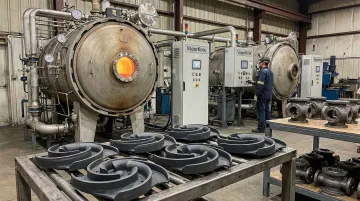
Both failures share a root cause: a surface that wasn't hard enough to resist the operating environment. Advanced surface treatments address this directly. VaporKote's diffusion coatings — boronizing and aluminizing — form an intermetallic compound at the base metal surface, achieving 1500 Knoop hardness (RC75+ equivalency). That surface hardness is what keeps precision components holding their tolerances in corrosive, abrasive, and high-temperature conditions.
How to Get the Most Value from High-Precision Components
Precision components deliver their full value only when selected, specified, and maintained as part of a deliberate strategy—not treated as a commodity procurement decision.
Practical approach:
- Specify to the correct tolerance using GD&T frameworks (ASME Y14.5 or ISO 1101) to control geometric relationships between features — over-engineering costs money, but under-specifying costs more
- Verify incoming components against documented standards to confirm suppliers deliver exactly what was specified
- Establish predictive maintenance intervals based on actual wear behavior under operating conditions, not arbitrary calendar dates
Surface protection is where the economics shift most sharply in your favor. Boronizing achieves extreme surface hardness (1,400–2,000 HV, exceeding 70 HRC)—harder than tungsten carbide cutting tools. This metallurgical bond outlasts superficial coatings and preserves micron-level tolerances against severe wear.
For example, boronizing 17-4PH stainless steel fluid pump components reduced the wear rate by a factor of five, allowing the pump to operate flawlessly in downhole environments without obvious surface wear. VaporKote's boronizing process achieves RC75+ equivalency surface hardness — locking in the tolerances your precision components were built to hold across their full service life.
Conclusion
Precision manufacturing ultimately comes down to control: over performance, costs, compliance, and operational risk. Each of these advantages compounds over time when precision is built in from specification through to surface protection.
Precision is an ongoing operational practice, not a one-time specification decision. Manufacturers who apply it at every stage—from tolerance selection to surface protection—outperform those who treat it as a cost to minimize. The gap shows up in measurable ways:
- Higher uptime percentages and fewer unplanned stoppages
- Leaner maintenance budgets with fewer emergency replacements
- Scalable operations that don't introduce variability as volume grows
Frequently Asked Questions
What are high precision components?
High-precision components are parts manufactured to extremely tight dimensional tolerances—often within thousandths of an inch—so they fit and perform exactly as designed within a larger mechanical system, maintaining consistent performance and predictable wear over time.
What is an example of high precision in manufacturing?
Turbine blade airfoils in aerospace engines maintain tolerances within microns to preserve aerodynamic efficiency. Similarly, pump impellers in oil refining equipment require dimensional accuracy to directly control flow rate and pressure performance.
What is the difference between CNC and HMC?
CNC (Computer Numerical Control) refers to the broad category of automated machining driven by programmed instructions. An HMC (Horizontal Machining Center) is one specific CNC configuration — the spindle runs horizontally, which makes it well-suited for high-volume, multi-side machining of complex parts.
Why is precision important in manufacturing?
Precision ensures components perform as designed, fit correctly within assemblies, and meet regulatory standards. Even small dimensional deviations can cause accelerated wear, system failures, safety risks, and costly unplanned downtime in critical industrial applications.
What industries rely most on high-precision components?
Aerospace, oil & gas, petrochemical, mining, defense, medical devices, and agriculture all depend heavily on precision components. In each of these sectors, component failure carries serious consequences — making dimensional accuracy and surface integrity critical by design.
How do surface coatings help preserve precision component performance?
Surface wear, corrosion, and thermal degradation gradually erode a component's dimensions — even when originally machined to spec. Diffusion coatings like boronizing restore surface hardness and corrosion resistance, helping components hold their designed tolerances longer in demanding environments.